

Most travelers choose their travel connectivity the same way they reluctantly pick a middle seat, without comparing options, and slightly regret it afterward.
This guide fixes eSIM vs Physical SIM. We’ve broken down the real costs, hidden charges, and practical trade-offs of all three options so you can make an informed decision before your next trip, not after you’ve seen the bill.
1. The Real Cost Comparison Numbers That Actually Matter
Let’s cut straight to the numbers. The scenario: a 7-day trip with moderate data use (approximately 5 GB).
International Roaming: What Major Carriers Charge
| Carrier / Region | Daily Roaming Pass | 7-Day Total |
|---|---|---|
| US carriers (AT&T, Verizon, T-Mobile) | $10–$15/day | $70–$105 |
| UK carriers (EE, Vodafone, O2) | £5–£8/day | £35–£56 |
| Indian carriers (Airtel, Jio) | ₹299–₹599/day | ₹2,093–₹4,193 |
| Australian carriers (Telstra, Optus) | $10–$12/day | $70–$84 AUD |
Physical Local SIM Cost at Popular Destinations
| Destination | Local SIM Cost | Data Included |
|---|---|---|
| Thailand | $5–$8 | 10–15 GB |
| Japan | $10–$15 | 5–10 GB |
| Philippines | $3–$5 | 5–8 GB |
| Singapore | $8–$12 | 5–10 GB |
| Europe (multi-country) | $15–$25 | 10–20 GB |
eSIM Plans Commbitz eSIM Pricing
| Destination | eSIM Plan Cost | Data Included |
|---|---|---|
| Thailand | $6–$10 | 5–10 GB |
| Japan | $10–$18 | 5–10 GB |
| Philippines | $8–$12 | 5–10 GB |
| Singapore | $8–$15 | 5–10 GB |
| Europe (multi-country) | $12–$20 | 10–20 GB |
The numbers tell a clear story:
- 🥇 Local SIM — lowest cost in most single-destination trips
- 🥈 eSIM — matches local SIM pricing closely, with significant convenience advantages
- 🥉 Roaming — costs 5x to 10x more than the alternatives in almost every market
2. Full Feature Comparison Table
| Feature | eSIM | Physical SIM | Roaming |
|---|---|---|---|
| 7-day cost (5 GB) | 💚 $6–$20 | 💚 $3–$25 | 🔴 $35–$105+ |
| Activate before travel | ✅ Yes | ❌ No | ✅ Automatic |
| Works on arrival, no setup | ✅ Yes | ❌ Requires store visit | ✅ Yes |
| Store visit required | ❌ No | ✅ Yes | ❌ No |
| Risk of hidden charges | ❌ None | ❌ None | 🔴 High |
| Works across multiple countries | ✅ Regional plans | ❌ Usually, one country | ✅ Yes |
| Keeps home phone number active | ✅ Dual SIM | ❌ Replaces home SIM | ✅ Yes |
| Risk of losing the card | ❌ None | ✅ Physical card | ❌ None |
| Data speed | 💚 4G/LTE | 💚 4G/LTE | ⚠️ Varies by agreement |
| Compatible devices | ⚠️ Newer smartphones | ✅ Almost all phones | ✅ All phones |
3. Hidden Charges Most Travelers Never See Coming
Roaming costs far more than the advertised daily rate. Here are the charges that appear on bills and catch travelers completely off guard:
Background data consumption — apps refresh automatically in the background. Cloud sync, email, system updates — all running on roaming rates without a single tap from you.
Video autoplay — social media platforms autoplay video content by default. One minute of autoplay on roaming can consume more data than an hour of messaging.
Hotspot tethering premiums — sharing a roaming connection to a laptop often triggers separate, higher-rate charges on many carrier plans.
Incoming call charges — some international roaming plans bill you for receiving calls, not just making them. The person calling you pays nothing. You pay per minute.
Automatic country switching — crossing a land border or even sailing close to a neighboring country’s coast can trigger an automatic network switch to a higher-rate roaming partner. It happens overnight. It shows on your bill.
“Free roaming” throttling traps — plans marketed as “free roaming” often cap data at a daily threshold, then throttle speeds to 2G or lower. Google Maps barely loads. Streaming stops entirely. The “free” roaming becomes useless precisely when you need it most.
Neither eSIM nor local SIM carries any of these risks. Both operate on fixed-price plans; you know the cost upfront, and that is the cost, full stop.
4. Which Is Cheapest for short trips: eSIM vs. physical SIM?
Trip length: 1 to 5 days
On a short trip, price differences between eSIM vs Physical SIM are minimal, often just a few dollars. The real differentiator is time.
Purchasing a local SIM at an international airport typically takes 30 to 60 minutes: find the store, show ID, choose a plan, wait for activation, troubleshoot if it doesn’t work the first time. On a 3-day trip, that’s a material chunk of your time better spent actually being at your destination.
An eSIM activates in under 10 minutes from home before you travel. You land connected. You clear customs. You’re already navigating.
Verdict: eSIM wins for short trips due to the combination of comparable price and significantly lower time cost.
5. Which Is Cheapest for Long Trips: eSIM vs. physical SIM?
Trip length: 2 weeks or more
For extended stays in a single country, a local SIM purchased at the destination often edges out an eSIM on per-GB pricing, sometimes by $5 to $10 over a month. Local carriers competing in their own market offer the most aggressive pricing, which eSIM providers routing through those same networks can’t always match exactly.
That said, roaming remains completely unworkable for long trips. At $10/day, a 30-day trip costs $300 in roaming alone for data that a local SIM or eSIM would provide for $15 to $30.
Verdict: eSIM vs Physical SIM are close. Roaming is not a serious option for trips over one week.
6. Which Option Suits Your Travel Style?
| Traveler Type | Recommended Option | Reason |
|---|---|---|
| Leisure traveler — 1 to 2 weeks | eSIM | Easy pre-travel setup, no store visit |
| Business traveler — multi-country | eSIM | Regional plans keep the home number on Dual SIM |
| Long-term backpacker — 1 to 3 months | Local SIM | Best per-GB pricing for extended single-country stays |
| Digital nomad | eSIM + local SIM backup | Reliability of both, flexibility to switch |
| First-time international traveler | eSIM | Simplest setup, no language barriers at foreign counters |
| Family group | eSIM per person | Individual plans, no SIM juggling across devices |
7. Real Savings: eSIM vs Roaming Across Popular Destinations
These numbers represent actual savings when switching from carrier roaming to a Commbitz eSIM plan:
| Trip Scenario | Roaming Cost (est.) | Commbitz eSIM | You Save |
|---|---|---|---|
| 5 days in Japan | $50–$75 | $10–$18 | $32–$65 |
| 7 days in Southeast Asia | $70–$105 | $8–$12 | $58–$97 |
| 10 days in Europe | $100–$150 | $12–$20 | $80–$130 |
| 14-day multi-country Asia trip | $140–$210 | $15–$25 | $115–$185 |
| 30-day long-term trip | $300–$450 | $20–$40 | $260–$410 |
Across consistent international travel, these savings compound significantly over a year.
8. Why Regional eSIM Plans Win for Multi-Country Travel
For trips crossing multiple countries, Southeast Asia island-hopping, a European rail journey, or a Middle East layover tour, the local SIM model breaks down entirely.
A local SIM is tied to one country. Cross a border, and you’re either:
- Buying another SIM at the next country’s airport (time + money + another queue)
- Falling back on roaming while you sort it out (expensive)
- Going offline entirely (inconvenient)
A regional eSIM plan solves all three problems simultaneously. One plan, one QR code, multiple countries.
Commbitz eSIM offers regional plans covering:
- Asia Pacific (including the Philippines, Japan, Thailand, Singapore, Malaysia, and more)
- Europe (30+ countries under a single plan)
- Americas and Middle East regional options
One activation. No border data gaps. No new SIM in every country.
9. How to Activate an eSIM in Under 10 Minutes
If your phone supports eSIM and is network-unlocked, the process is straightforward:
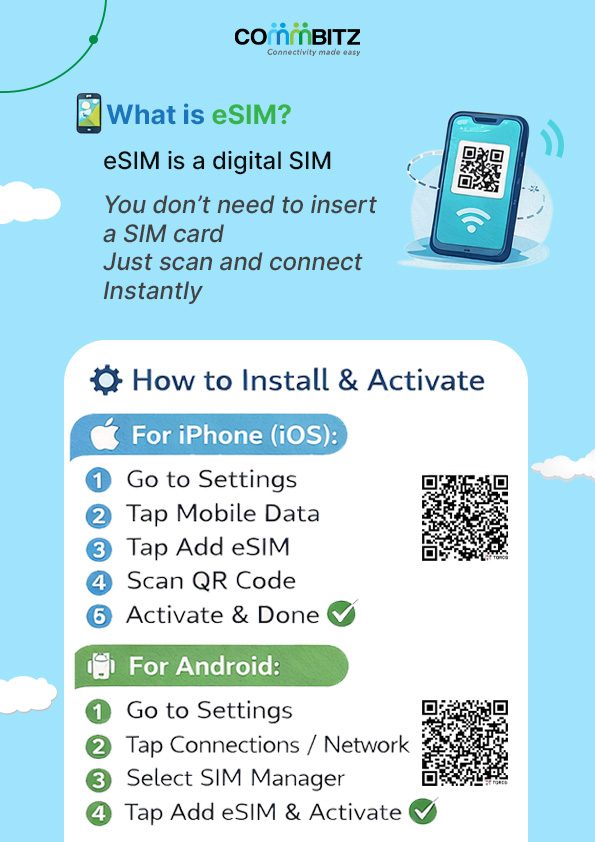
Step 1: Visit commbitz.com and select your destination or region
Step 2: Choose a data plan based on your trip length and usage
Step 3: Complete your purchase — a QR code is sent to your email immediately
Step 4: On your phone, go to Settings → Cellular / Mobile Data → Add eSIM
Step 5: Scan the QR code from your email
Step 6: Label the plan (e.g., “Japan Trip“) and set it as your data line
Step 7: Land at your destination — your eSIM activates on arrival ✅
Total time: 5 to 10 minutes. Done entirely from home before you travel.
10. Fun Facts About Travel Connectivity
- Over 1 billion eSIM-compatible devices are in active use globally as of 2025
- The average international traveler on roaming overspends by $50–$150 per trip compared to eSIM users
- iPhone models sold in the USA from iPhone 14 onward are eSIM-only, with no physical SIM tray
- A single phone can store multiple eSIM profiles and switch between them without any hardware change
- Most eSIM plans operate on the same 4G/LTE networks as local SIMs, on the same tower, with a fraction of the roaming cost
- eSIM technology is now accepted across 200+ countries and territories worldwide
- Global eSIM adoption is growing at approximately 40% year on year as awareness increases among travelers
11. FAQs
Q1: Is eSIM always cheaper than roaming? In almost every scenario, yes. Carrier roaming passes typically run $5 to $15 per day. A 7-day eSIM plan for the same destination generally costs $8 to $20 total, the equivalent of one or two roaming days. For any trip longer than a weekend, the cost difference is substantial.
Q2: When does a local SIM beat an eSIM on price? For extended single-country stays, typically four weeks or more, local SIM cards purchased at the destination can offer slightly better per-GB pricing because local carriers compete aggressively in their home market. The cost difference is usually $5 to $15 over a month. For shorter trips or multi-country itineraries, eSIM is competitive or cheaper.
Q3: Can I keep my regular number active while using a travel eSIM? Yes, on any phone that supports Dual SIM functionality. Most modern smartphones allow one physical SIM (your home number for calls and texts) and one eSIM (your travel data plan) to run simultaneously. You remain reachable on your regular number without paying roaming rates for data.
Q4: Are there any surprise charges with eSIM? No. eSIM plans are fixed-price: you pay for a data allowance and use it. When the allowance runs out, data either stops or you top up at a transparent rate. Unlike roaming, there are no per-MB overages, no automatic country-switch charges, and no background consumption fees appearing on your home carrier bill.
Q5: Which is the better choice for a multi-country trip, eSIM or roaming? eSIM, clearly. A single regional eSIM plan from Commbitz covers multiple countries with a single purchase and activation. Roaming works across countries too, but at 5 to 10 times the cost. Local SIMs require a new purchase in each country. For multi-destination itineraries, a regional eSIM is the most cost-effective and practical solution available.
Final Word
The comparison reduces to something simple:
- Roaming offers maximum convenience at maximum cost. Appropriate only when the price is genuinely irrelevant
- Local SIM excellent value for single-country, longer-term stays. Requires a store visit on arrival
- eSIM matches local SIM pricing, activates before you travel, works across multiple countries, and carries zero hidden charge risk
For the majority of international travelers, whether that’s a 5-day business trip or a 3-week multi-country holiday, eSIM is the best overall value when price, convenience, and reliability are weighed together.
The savings are real. The setup is simple. The only question is why you haven’t switched already.
🌍 Ready to Stop Overpaying for Travel Data?
Compare plans, activate before you fly, and land connected. 👉 Explore Commbitz eSIM plans at commbitz.com: data plans for 200+ countries, no hidden charges, no store visit required.
Share this guide with anyone still paying daily roaming rates. They’ll thank you. 📱✈️
Get 10% OFF — Download Our App Now!
Enjoy instant savings when you buy eSIMs through our app.