
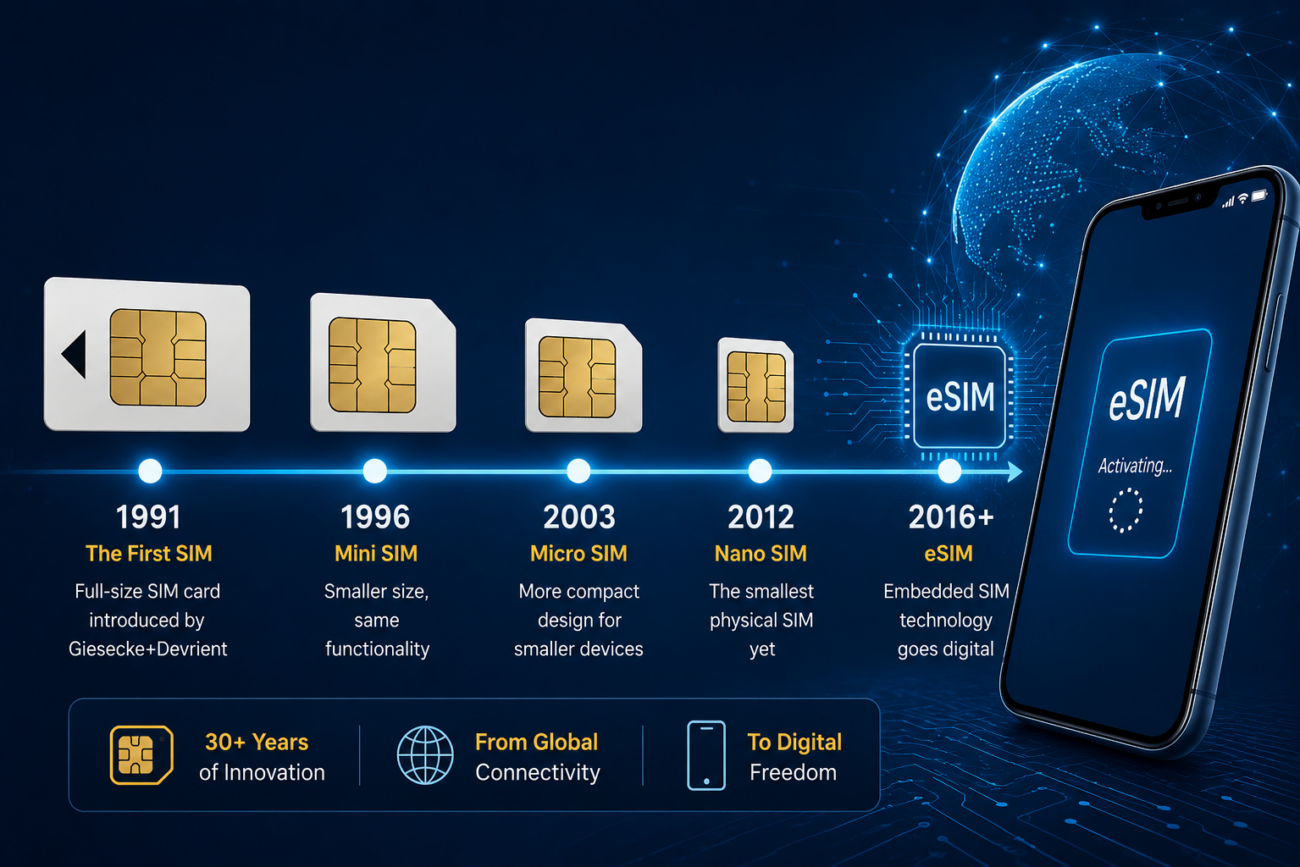
The SIM card was invented in 1991 by German smart card maker Giesecke & Devrient, evolving from a credit-card-sized chip into the mini-SIM, micro-SIM, and nano-SIM and finally into the eSIM (embedded SIM), a digital SIM card that has made physical SIM cards optional on modern smartphones. Today, travelers use an eSIM for international travel to get instant, physical-SIM-free connectivity in 190+ countries, and companies like Commbitz are leading that shift.
Every time you land in a new country and your phone reconnects to a network in seconds, you’re relying on more than three decades of quiet engineering. The SIM card Subscriber Identity Module is one of the most successful pieces of technology ever built, and almost nobody thinks about it. This blog traces its full journey: from the first plastic chip in 1991 to the eSIM technology that now powers global travel connectivity, and what it means for anyone comparing a physical SIM vs eSIM for their next trip.
What Is a SIM Card and Why Was It Invented?
A SIM card is a small chip that stores the data a mobile network needs to identify you: your IMSI (International Mobile Subscriber Identity), an authentication key, and network configuration details. Without it, a phone is just hardware it can’t prove to a network who it’s billing or authorizing.
Before the SIM card existed, phone identity was often tied to the device itself, which made switching phones or carriers painful. The GSM standard, developed in Europe in the late 1980s, needed a way to separate a person’s subscription from their handset. The solution was a removable smart card and in 1991, the first working SIM card was produced by Giesecke & Devrient for the Finnish network operator Radiolinja, marking the official birth of mobile network authentication as we know it.
That single design decision making identity portable and swappable is the reason SIM cards (and now eSIMs) still dominate global mobile connectivity today.
How Has the SIM Card Evolved?
The SIM card didn’t shrink because of one big leap it shrank in stages, each driven by phones getting smaller and manufacturers needing more internal space for batteries, cameras, and processors.
1. Full-size SIM (1991) About the size of a credit card, this original format was mostly card body with a small embedded chip. It was rarely inserted directly into phones; instead, users would punch out the usable chip portion.
2. Mini-SIM (1996) Roughly 25mm x 15mm, this became the “standard SIM” most people picture the size used in phones through the early 2000s and into the first-generation smartphones.
3. Micro-SIM (2010) Popularized by the iPhone 4, the micro-SIM trimmed excess plastic while keeping the same chip, allowing thinner phone designs without changing the underlying electronics.
4. Nano-SIM (2012) Introduced with the iPhone 5, the nano-SIM remains the smallest removable SIM format in wide use today, about 40% smaller than the mini-SIM.
5. eSIM (2016 onward) Instead of a removable card, the eSIM is a chip soldered directly onto the device’s circuit board. It’s reprogrammable over the air, meaning a phone can switch carriers or add a travel data plan without ever touching a physical card.
Each shrinkage step solved a hardware problem. The eSIM solved a completely different problem: flexibility. It let devices manage multiple carrier profiles digitally, laying the foundation for the on-demand global connectivity travelers expect today.
Also read: eSIM Not Working? Don’t Panic, Here’s How to Fix It 📱
What Is an eSIM and How Is It Different From a Physical SIM Card?
An eSIM (embedded SIM) performs the same job as a physical SIM, identifying you to a mobile network, but it’s built into the device permanently and programmed digitally instead of being swapped by hand.
| Feature | Physical SIM | eSIM |
| Installation | Insert physical card | Scan a QR code or install digitally |
| Switching carriers | Requires new physical card | Instant digital profile switch |
| Multiple numbers/plans | One at a time (unless dual-SIM slot) | Multiple profiles stored simultaneously |
| Risk of loss/damage | Can be lost, damaged, or ejected | Cannot be physically removed or lost |
| Availability while traveling | Requires local SIM purchase or roaming | Can be purchased and installed before departure |
| Best for | Long-term single-carrier use | Frequent travelers, dual-SIM users, IoT devices |
This is exactly why the shift to eSIM matters most for travel. Apple, Google, and Samsung began building eSIM support into flagship phones from 2018 onward, and by the early 2020s, most new smartphones supported eSIM alongside or instead of a physical SIM tray. Some recent iPhone models sold in the U.S. have gone eSIM-only, dropping the physical tray entirely.
Why Are Travelers Switching to eSIMs?
If you’ve ever landed abroad and spent your first hour hunting for a SIM card kiosk, you already understand the problem eSIMs solve. Here’s what’s driving the shift:
- No physical card needed Buy and install a travel eSIM before you even leave home, and activate it the moment you land.
- No more roaming shock Traditional roaming charges can run into hundreds of dollars for a short trip; a prepaid international eSIM data plan is fixed and predictable.
- Keep your home number active Because eSIM-capable phones support dual profiles, you can keep your regular number for calls and texts while using a local data eSIM for browsing.
- Instant activation, anywhere No need to find a local store, show ID, or wait in line. Everything happens through a QR code or app.
- One eSIM, multiple countries Regional and global eSIM plans (covering entire continents or 190+ countries) mean you don’t need a new SIM at every border.
- Better for the planet Fewer plastic SIM cards manufactured, shipped, and discarded.
This is the exact gap Commbitz was built to close. Instead of gambling on airport SIM kiosks or paying inflated roaming fees, Commbitz lets travelers browse global, regional, and local eSIM plans, install an eSIM digitally in minutes, and stay connected across 190+ countries and 460+ networks all from one app, with transparent pricing and no hidden charges.
How Do You Install an eSIM?
Installing an eSIM typically takes under five minutes:
- Check device compatibility. Most phones released after 2018 (iPhone XS and later, most Samsung Galaxy S20+ and newer, Google Pixel 3 and later) support eSIM.
- Purchase your eSIM plan Choose a local, regional, or global data plan based on your destination through the Commbitz app (also available on Google Play).
- Scan the QR code or tap “install.” You’ll receive a QR code by email or in-app; scanning it downloads the eSIM profile directly to your phone.
- Enable the eSIM line. Go to your phone’s cellular settings and turn on data roaming for the new eSIM profile.
- Connect automatically on arrival. Once you land, your phone latches onto the local network with no manual setup required.
No SIM ejector tool, no local carrier store, no language barrier at a counter just connectivity that’s ready before you board the plane.
Is the eSIM the Future of Mobile Connectivity?
Industry data increasingly points to yes. Analysts covering the mobile connectivity space project continued double-digit annual growth in eSIM adoption through the late 2020s, driven by smartphone manufacturers, IoT devices (smartwatches, tablets, connected cars), and the travel industry all standardizing around embedded, remotely provisioned SIM technology. Apple has already removed the physical SIM tray on U.S. iPhone models, and other manufacturers are expected to follow as more countries build out eSIM infrastructure.
That said, the physical SIM isn’t disappearing overnight. Many budget devices, feature phones, and markets with limited eSIM carrier support still rely on nano-SIMs. For the foreseeable future, the two formats will coexist but for smartphone users and international travelers specifically, the eSIM is quickly becoming the default.
Plan Your Trip Around Your Connectivity
Once your eSIM is sorted, the rest of the trip gets easier to plan too. Browse attractions and tours at your destination, or generate a free personalized itinerary to line up your data plan with your actual travel dates. If you’re a business looking to offer eSIM connectivity to your own customers, Commbitz also works with travel and tech partners through white-label and API integrations.
Frequently Asked Questions
When was the first SIM card invented?
The first SIM card was created in 1991 by Giesecke & Devrient for Radiolinja, a Finnish mobile network operator.
What does SIM stand for?
SIM stands for Subscriber Identity Module, the chip that identifies a user to a mobile network.
What’s the difference between a SIM card and an eSIM?
A SIM card is a removable physical chip; an eSIM is built into the device and activated digitally, with no physical card to insert or swap.
Can I use an eSIM and a physical SIM at the same time?
Yes. Most modern eSIM-capable phones support dual-SIM functionality, letting you keep your home number active on a physical SIM while using an eSIM for local or travel data.
Is an eSIM safe to use?
Yes. eSIM technology uses the same GSMA-standardized authentication and encryption as physical SIM cards, and because it can’t be physically removed, it’s harder to lose or tamper with.
How do I get a travel eSIM before my trip?
Download the Commbitz app or visit the Commbitz eSIM store, choose a local, regional, or global data plan for your destination, and install the eSIM via QR code before you depart so you’re connected the moment you land.