
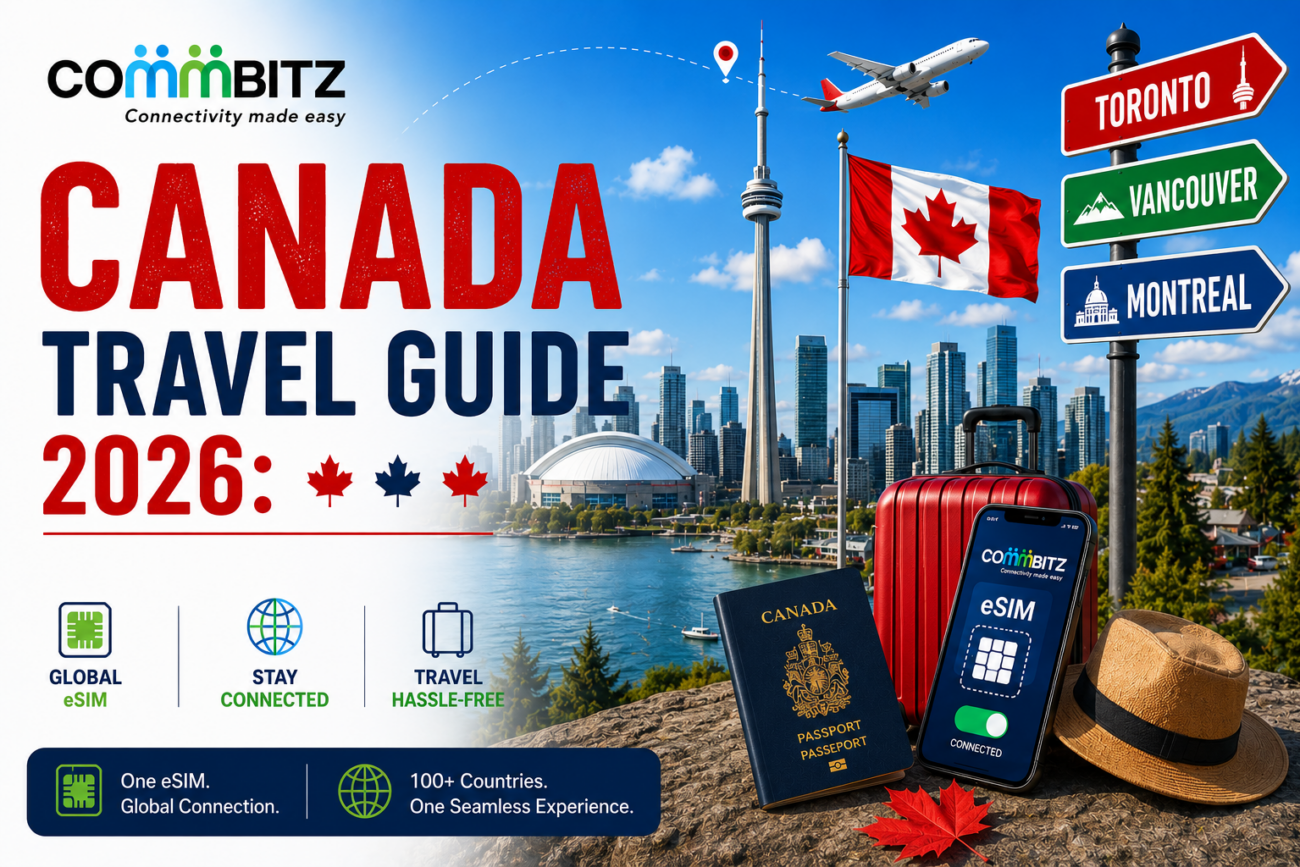
Experience Canada’s Iconic Cities & Natural Wonders
Canada gets 45+ million visitors a year. Most of them hit the same three cities and love it. Toronto if you want urban energy and Niagara Falls nearby. Vancouver if you want mountains and ocean views. Montreal if you want European charm without the flight. This guide covers what actually matters for a Canada travel in 2026.
QUICK FACTS
| Best Time | June-September (warm, everything’s open) |
| Where | Toronto, Vancouver, Montreal (the big three) |
| What to See | Niagara Falls, Rocky Mountains, National Parks |
| Annual Visitors | 45+ million from 200+ countries |
| Budget | USD $1,200-15,000+ (depends how you travel) |
| Stay Connected | Commbitz eSIM (works all 10 provinces) |
WHAT IS THE BEST TIME TO GO CANADA Travel?
June-August (Peak Summer): Warm (68-79°F), everything’s open, prices are high, crowds are ridiculous. But the weather is perfect.
April-May or September-October (Shoulder): The sweet spot. Weather’s still nice (50-68°F), way fewer tourists, cheaper hotels. This is when locals travel.
November-February (Winter): Cold (-5 to 5°F), but skiing is world-class. Hotels are cheap. Northern Lights happen if you’re into that.
Honestly? Come in September if you can. You get all the summer activities, the fall colors start showing up, and you avoid fighting with families.
Best Cities to Visit in Canada for First-Time Travelers
1. Toronto Travel Guide: Niagara Falls, CN Tower & City Life
Getting there: Toronto Pearson Airport (YYZ). Take the GO Transit light rail downtown (40-50 minutes, way cheaper than Uber).
Why go: CN Tower (553 meters, you go to the top). Niagara Falls is 90 minutes away and absolutely worth the drive. St. Lawrence Market is a real neighborhood, not a tourist trap. King West and Queen West have actual bars and restaurants locals use.
Weather in June: 68-79°F. Perfect.
Cost: Hotels run CAD $130-280/night (USD $100-210). Food: budget $15-35/day for casual eating, $50-100/day for nicer restaurants. TTC subway costs CAD $2.50 per ride.
The vibe: Canada’s largest city, obviously busy, but not in a bad way. Museums are solid. Theater scene is legitimate.
Perfect for: First-time Canada visitors, people who want urban stuff and nature nearby, families.
Real tip: Skip the CN Tower if you’re not that into observation decks. Get lunch on King West instead.
Also read: Phuket Vegetarian Festival 2026: What to Eat, See & Do
2. Vancouver: Mountains, Nature & Coastal Views
Getting there: Vancouver International Airport (YVR). Canada Line rapid transit gets you downtown in 20-30 minutes.
Why go: Stanley Park is huge (400 hectares) and you can walk the whole thing. Granville Island has actual food vendors and artists, not Instagram traps. Capilano Suspension Bridge is as cool as it sounds. Whistler is close by if you want skiing or just mountain views.
Weather in June: 64-75°F, cool but nice.
Cost: Hotels CAD $120-250/night (USD $90-190). Food: CAD $12-30/day budget, CAD $60-120/day for good restaurants. Salmon here is actually worth eating.
The vibe: Outdoor people. Mountains literally meet the ocean. Hiking and kayaking culture is real. Less touristy than Toronto.
Perfect for: Nature lovers, hikers, photographers, people who actually want to be outside. Skiers (Whistler’s close).
Real tip: Rent a bike and ride around Stanley Park. Skip the suspension bridge if you’re afraid of heights.
3. Montreal: French Culture, Food & History
Getting there: Montreal-Pierre Elliott Trudeau International (YUL). Airport transit or shuttle gets you downtown in 20-30 minutes.
Why go: Old Montreal is genuinely historic (cobblestone streets, old buildings). Basilica is beautiful if you’re into that. The food scene is legit poutine, bagels, smoked meat. It feels European without requiring a passport. Festivals happen constantly.
Weather in June: 64-77°F, comfortable.
Cost: Hotels CAD $100-220/night (USD $75-165). This is the cheapest of the three cities. Food: CAD $12-28/day budget, CAD $40-80/day for nice places. Subway is CAD $1.50 per ride.
The vibe: Cultural, artsy, French, but English works fine in tourism areas. Nightlife is good. People are friendly.
Real language note: French is primary, but English-speakers get by. Learn “merci” and “s’il vous plaît” and people appreciate it.
Perfect for: History lovers, foodies, culture people, artists, couples.
Real tip: Spend time in neighborhoods (Plateau, Mile End). Skip some of the touristy basilica stuff if you’re not interested.
QUICK CITY COMPARISON
| Toronto | Vancouver | Montreal | |
| Airport | YYZ (25km) | YVR (10km) | YUL (20km) |
| Best For | Urban + Niagara | Mountains + nature | Culture + history |
| Budget | Mid | Mid-High | Lower |
| Vibe | Historic capital | Pacific adventure | French culture |
THE BEST MONTHS, REAL TALK
| Month | Temp | Best For | What’s Open | Price |
| April-May | 50-59°F | Spring hiking | Trails opening up | Budget |
| June | 68-73°F | Summer starting | Everything | Mid |
| July-August | 73-79°F | Peak summer | Everything, packed | Expensive |
| September-October | 59-68°F | Fall foliage | Everything | Budget |
| November-February | 23-32°F | Skiing | Mountains open | Cheap |
If you hate crowds, skip July-August. Go in September when it’s still nice and everyone’s back at work.
BUDGET BREAKDOWN
Budget Trip (2 weeks): USD $1,200-2,500
- Flights: USD $300-600 (book early)
- Hotels: USD $40-75/night (budget chains, Airbnb)
- Meals: USD $20-30/day (street food, casual places)
- Attractions: USD $100-300 (parks, museums, Niagara)
- Transport: USD $150-250 (public transit, occasional Uber)
- Commbitz eSIM: USD $25-40 (works everywhere)
Mid-Range Trip (2 weeks): USD $3,000-6,000
- Flights: USD $400-800 (flexible)
- Hotels: USD $100-150/night (3-4 star)
- Meals: USD $50-80/day (mix of restaurants)
- Attractions: USD $200-400 (tours, activities)
- Transport: USD $300-500 (car rental option, flights between cities)
- Commbitz eSIM: Included
Luxury Trip (2 weeks): USD $6,500-15,000+
- Flights: USD $800-1,500 (business class)
- 5-star hotels: USD $200-350/night
- Meals: USD $100-300/day (fine dining)
- Guided tours: USD $400-800 (helicopter, private guides)
- Activities: USD $600-1,200 (luxury experiences)
Also read: Best International Travel eSIM – A Complete Guide for Seamless Global Connectivity
GETTING AROUND BETWEEN CITIES
- Flights (Best option): Toronto to Vancouver takes 5-6 hours. Toronto to Montreal is 1.5 hours. Air Canada, WestJet, or budget Flair. Book 2-3 months ahead. Costs CAD $150-400 (USD $120-300).
- Train (If you’re not in a rush): VIA Rail is scenic but slow. Toronto to Vancouver takes 72 hours. CAD $300-600 (USD $225-450). Good if you want to see the country slowly.
- Buses (Cheap, slow): Greyhound/Megabus. CAD $40-150 (USD $30-115). Takes forever but works if you’re budget-conscious.
- Real advice: Just fly. Life’s too short for 24-hour bus rides.
WHAT TO ACTUALLY DO
Must-See Attractions:
- Niagara Falls (90 minutes from Toronto, worth the drive)
- CN Tower in Toronto (go to the top if you like heights)
- Stanley Park in Vancouver (walk it, don’t skip)
- Old Montreal (walk around, eat poutine)
- Rocky Mountains from Banff National Park (5-7 hours from Vancouver, spectacular)
- Capilano Suspension Bridge in Vancouver (it’s a real experience)
- Whistler if you’re into skiing or just mountain scenery
Book early. Popular stuff fills up fast in summer.
GETTING CONNECTED: COMMBITZ eSIM
You need this. Seriously.
Why it matters:
- Activate before you land. No hunting for SIM cards at the airport.
- Works across all 10 provinces. Coast to coast, no dead zones.
- Bell, Rogers, Telus networks all covered.
- GPS works offline and online.
- Book hotels, check flight status, use Uber anywhere.
- CAD $25-40 (USD $20-30) for 2 weeks. International roaming costs USD $15-20 per day (USD $210-280 for 2 weeks). You save money immediately.
How to get it: Download the app before you leave. Pick your Canada plan. Activate 24 hours before you arrive. You and land are already connected.
What you’ll use it for:
- Google Maps while driving between cities
- Uber when you don’t want to hail a cab
- Last-minute hotel reservations
- Flight/train status updates
- Emergency calls
- Instagram posts from Niagara Falls
It’s the difference between having working GPS and getting lost.
A 2-WEEK ITINERARY
Days 1-5: Toronto
- CN Tower and neighborhood walks
- Day trip to Niagara Falls
- St. Lawrence Market
- King West for drinks and dinner
- Museums if you’re into that
Days 6-10: Vancouver
- Stanley Park (walk the whole thing)
- Granville Island
- Capilano Suspension Bridge
- Hiking or kayaking if you’re outdoorsy
- One day trip to Whistler if you have time
Days 11-14: Montreal
- Old Montreal walking tour
- Parc Mont-Royal
- Eat poutine, bagels, smoked meat
- Festivals if timing works
- Neighborhood exploring (Plateau, Mile End)
Throughout: Use Commbitz eSIM for navigation and booking.
Also read: Best International eSIM Data Plan – Complete Guide for Seamless Travel Connectivity
PRE-TRIP CHECKLIST
3 months before:
- Check passport (6+ months valid)
- Order Commbitz eSIM
- Book flights early
2 months before:
- Reserve hotels in 2-3 cities
- Plan which attractions you actually care about
- Buy travel insurance
1 month before:
- Book any tours you want
- Figure out city transportation
- Get your eSIM activated and tested
2 weeks before:
- Check weather for your dates
- Download offline maps
- Verify reservations
1 week before:
- Print confirmations
- Test your eSIM
- Pack comfortable walking shoes (seriously, wear good shoes)
THE BOTTOM LINE
Canada is beautiful. Safe. Welcoming. You can visit Toronto for museums and Niagara Falls, Vancouver for mountains and hiking, and Montreal for culture and food. Pick 2-3 cities, stay 2-3 days in each, fly between them, and you’ve had a solid Canada trip.
Book your flights 6+ weeks early. Reserve hotels immediately. Get Commbitz eSIM before you leave. Buy travel insurance. Pick September if you can.
Further Reading:
International eSIM India – A Complete Guide for Easy Global Connectivity
Best eSIM for USA from India – A Complete Guide for Travelers
Best Travel eSIM 2026 – The Smart Connectivity Guide for Global Travelers