
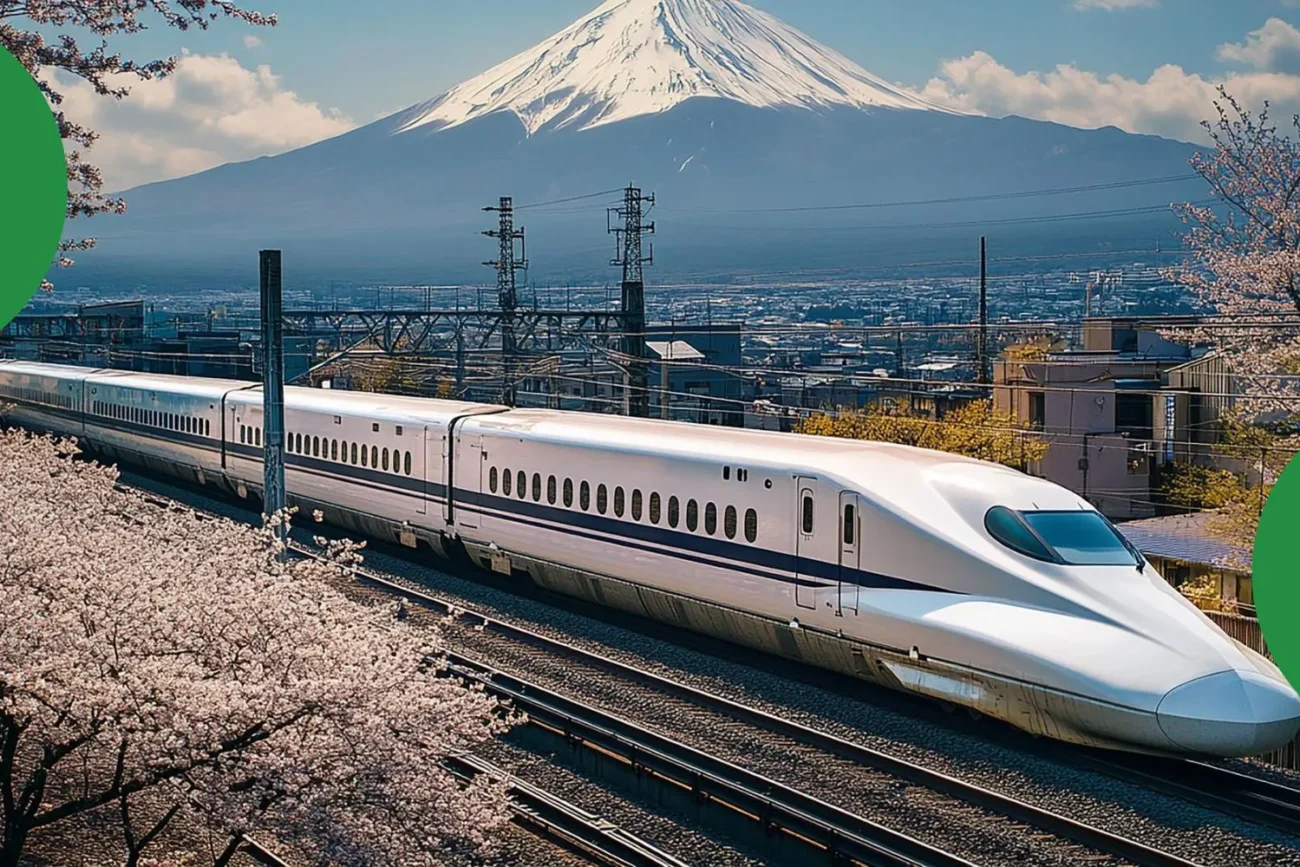
I grabbed the armrest, braced myself, and waited for the jolt.
It never came. The train just… glided. Smoothly, silently, impossibly fast. One second, we were at Tokyo Station surrounded by people and noise. Then we were gone, rice fields blurring past the window, Mount Fuji sliding into view like a postcard coming to life.
I’ve taken a lot of trains in many countries. Nothing comes close.
If you’re planning a trip to Japan and haven’t thought about riding the Shinkansen yet, rearrange your priorities. And if you have great. This guide covers everything you need to know, including the one thing most travel blogs forget to mention: how actually to stay connected while you’re on board.
What Is the Shinkansen, Anyway?
For anyone who doesn’t know, Shinkansen literally means “new trunk line” in Japanese. But everyone just calls it the bullet train. It’s a network of high-speed rail lines connecting almost every major city in Japan, running at speeds up to 320 km/h (about 200 mph).
Tokyo to Kyoto? Two hours fifteen minutes. Tokyo to Osaka? Two and a half hours. These are distances that would take five or six hours by car. The Shinkansen makes Japan feel small in the best possible way.
And it’s not just fast. It’s quiet. Clean. Punctual to the point where a one-minute delay gets a public apology from the conductor. The seats are wide and comfortable. There’s a tray table, a reclining seat, and outlets on newer trains. It genuinely feels more like a business class flight than a train.
Key Routes Worth Knowing
You don’t need to memorize the whole network. Just know the big ones:
Tokaido Shinkansen — Tokyo → Nagoya → Kyoto → Osaka. This is the most famous line and probably the one you’ll use most. It runs every few minutes during peak hours.
Sanyo Shinkansen — Osaka → Hiroshima → Fukuoka. Extends the Tokaido line westward. Hiroshima is a deeply moving day trip from Kyoto or Osaka.
Tohoku Shinkansen — Tokyo → Sendai → Aomori. Heads north. If you want to visit Nikko, Nikko, or the Tohoku region, this is your line.
Hokuriku Shinkansen — Tokyo → Kanazawa. Kanazawa is one of Japan’s most underrated cities and this line makes it ridiculously easy to visit.
The JR Pass covers most of these lines. If you’re doing more than two or three long-distance trips, do the math on whether a JR Pass saves you money; it often does.
Why Shinkansen Travel Is Unlike Anything Else
Here’s what gets me every time. You board in the middle of a huge, chaotic Japanese city. The train leaves on the dot. And within minutes, you’re watching rural Japan rush past little towns, mountain tunnels, fields of green. Then another city appears and swallows you up again.
It compresses the whole country into a single journey.
The food situation is also great, and I say this as someone who takes train snacks very seriously. Station bento boxes, called ekiben, are a genuine art form in Japan. Each region has its own specialties. Before a long Shinkansen ride, spend ten minutes in the station exploring the food stalls. Buy something you can’t identify. You probably won’t regret it.
The only thing that trips people up? Connectivity. And it trips up a lot of people.
The Truth About WiFi on the Shinkansen
Some Shinkansen trains, the newer Nozomi and Hikari services on the Tokaido line, offer onboard WiFi. Sounds great in theory.
In practice? It’s inconsistent. It drops in tunnels (and there are a lot of tunnels in Japan). It slows down when the carriage is busy. Streaming is basically out of the question. For quick messaging, it’s fine, but don’t rely on it for navigation or work calls.
This is why having your own mobile data isn’t optional; it’s essential.
Connectivity Tips: How to Stay Online the Whole Journey
The best solution for solo travelers: eSIM for Japan.
Before you even pack your bag, buy a Japan eSIM online. An eSIM is a digital SIM card you download it to your phone by scanning a QR code, no physical card involved. Takes about five minutes to set up. When you land in Japan, it activates automatically, and you’re online immediately.
On the Shinkansen, this means you’ve got your own data connection the whole ride. Google Maps works. Messaging works. You can look up your next destination, book a restaurant for when you arrive, or just scroll through your photos from the day. No, depending on the train’s WiFi, no dead zones stressing you out.
Japan eSIM plans are genuinely affordable, most start around $10–15 for several gigabytes of data, which covers a week or more of normal use comfortably.
Traveling with others? Consider Pocket WiFi.
A Pocket WiFi is a small rental device that creates a personal hotspot. Everyone in your group connects to it with phones, tablets, laptops, whatever. You can rent one at major airports when you arrive or book online before your trip for home delivery.
Pocket WiFi costs roughly $5–10 per day. Split between two or three people, it’s barely noticeable. The only thing to watch: make sure it’s charged before long journeys. Keep it in your bag, not your coat pocket; body heat drains the battery faster than you’d think.
One habit I’ve built for every Shinkansen trip: before I board, I download offline Google Maps for my destination city. Takes two minutes at the station. If I hit a dead zone in a mountain tunnel or my data acts up, I still have full navigation when I arrive. Small thing. Genuinely useful.
Beginner Tips for Riding the Shinkansen
Reserve your seat. Most Shinkansen tickets come with reserved or unreserved options. Reserved is worth the small extra cost, especially on busy holiday weekends. You’ll have a guaranteed seat number and won’t need to rush.
Get to the platform early. Each carriage has a marked waiting area on the platform. Stand in the right spot, and the train doors will open right in front of you. It’s oddly satisfying.
Be quiet in the carriage. Japan takes train etiquette seriously. Phone calls in the main carriages are frowned upon. Keep your voice low, silence your phone, and eat tidily if you’ve brought food. Nobody says anything if you break these rules, but everyone notices.
Window seat on the right side from Tokyo to Kyoto if you want the best view of Mount Fuji. It appears roughly 40–45 minutes into the journey — keep your phone ready.
A green car is worth it sometimes. The Green Car is Japan’s first class — wider seats, more legroom, quieter atmosphere. It costs more, but on a two-hour journey it’s a genuinely lovely way to travel.
Things to Avoid on the Shinkansen
Don’t show up without a ticket. You can’t just turn up and hop on. Buy tickets at the station counter, through the JR Pass, or on the Smart EX app. The conductors do check.
Don’t rely solely on train WiFi. As mentioned, it exists, but it’s unreliable. Sort out your own data connection before you travel.
Don’t eat smelly food. Cup noodles, strong-smelling snacks, or anything pungent — please don’t. Your carriage companions will be silently judging you for the entire journey.
Don’t miss your stop. The train moves fast, and stops aren’t always long. Know your station name in Japanese characters (not just romaji), watch the signs, and be ready to move when you arrive.
Honestly? The Shinkansen Is Part of the Trip
I used to think of trains as just transport, a way to get from A to B. The Shinkansen changed that for me.
There’s something about sitting in a quiet, comfortable carriage, watching Japan’s landscape shift from city to mountain to sea to city again, all while going faster than most planes take off — it’s meditative. It’s exciting. It’s both at once, somehow.
Shinkansen travel is one of those experiences that makes you genuinely sad when the journey ends. You step off the train and think, I could have done another two hours, easy.
Sort your tickets early. Get your eSIM or Pocket WiFi before you fly. Grab a bento box from the station. Sit by the window.

Japan is waiting right outside it. 🚄
FAQs
Q1: Do I need to book Shinkansen tickets in advance? It’s strongly recommended, especially during Golden Week (late April to early May), Obon (mid-August), and the New Year. At quieter times, you can sometimes buy at the station, but reserved seats sell out fast on popular routes.
Q2: Is the JR Pass worth buying for Shinkansen travel? It depends on how much you travel. If you’re doing Tokyo → Kyoto → Hiroshima → back, it usually pays for itself. For shorter trips or just one long journey, individual tickets might be cheaper. Use the Hyperdia website to calculate.
Q3: Does the Shinkansen have WiFi? Some trains do, but it’s inconsistent and unreliable, especially in tunnels. Don’t count on it. Bring your own data via an eSIM or Pocket WiFi rental.
Q4: Can I eat on the Shinkansen? Yes! Eating on the Shinkansen is totally normal and part of the culture. Just avoid strong-smelling food out of courtesy. Station ekiben (bento boxes) are delicious and specifically designed for the journey.
Q5: What’s the fastest Shinkansen in Japan? The Alfa-X prototype has hit 360 km/h in testing. Still, commercially, the fastest regular service is the L0 Series Maglev, which runs at 603 km/h in tests and is being developed for passenger service between Tokyo and Nagoya. For now, the fastest regular trains you can ride top out around 320 km/h on the Tokaido line.
Get 10% OFF — Download Our App Now!
Enjoy instant savings when you buy eSIMs through our app.