
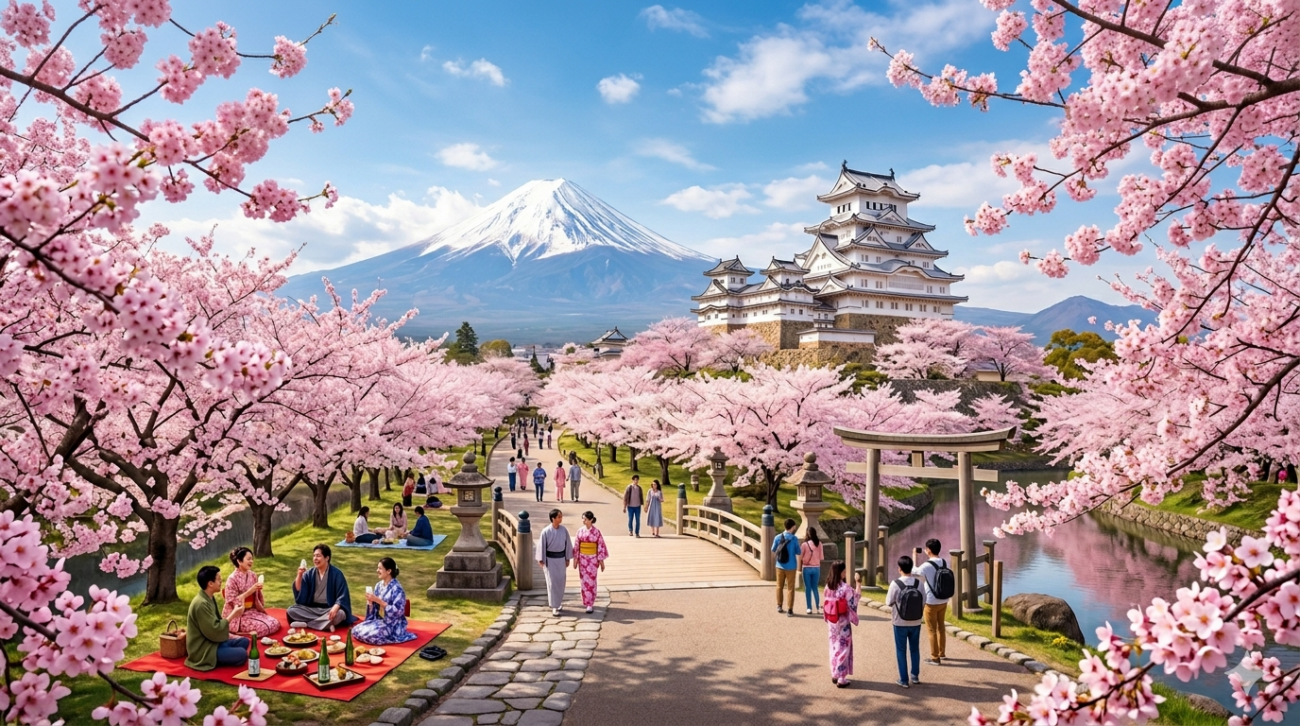
2026 Quick Answers – Cherry Blossom Season in Japan
• Tokyo first bloom (kaika): March 19 | Full bloom (mankai): ~March 27 – earlier than average
• Kyoto / Osaka full bloom: ~April 3–4 | Hokkaido / Sapporo: Late April – early May
• How long do blossoms last? 7–14 days; peak viewing (mankai) just 5-7 days
• Best time to book: 4-5 months ahead – October/November for March/April travel
• Forecast source: Japan Meteorological Corporation (JMC) – updated weekly from January
Stay connected from day 1: Activate your Japan eSIM from Commbitz
Japan’s cherry blossom season is one of the most celebrated natural events on earth, and in 2026, the sakura arrived earlier than usual.
When Do Cherry Blossoms Bloom Across Japan?
Peak bloom occurs March 25-April 10 in major tourist regions (Tokyo, Kyoto, Osaka). However, early February blooms occur in Okinawa and late April-May blooms occur in Hokkaido, creating a 3-month-long season across the country. Bloom timing shifts 5-10 days annually based on winter temperatures and spring weather patterns.
Japan Cherry Blossom Forecast 2026 – Dates by Region
The Japan Meteorological Corporation releases official bloom forecasts in mid-January each year, updated weekly through April. This data precision lets you plan specific travel dates with confidence rather than guessing.
| Region | First Bloom | Full Bloom | Season Length | Notes |
| Okinawa | Late January | Early February | ~14 days | Kanhi-zakura variety |
| Kyushu (Fukuoka) | Mid-March | March 18–28 | ~12 days | Japan’s earliest mainland city |
| Kanto (Tokyo) | March 19 | ~March 27 | 10–14 days | 2026: earlier than average |
| Izu (Kawazu) | Late February | Early March | ~3 weeks | Kawazu-zakura deepest pink |
| Kansai (Kyoto/Osaka) | Late March | April 3–4 | 10–14 days | Temple gardens at their finest |
| Hiroshima/Himeji | Late March | April 1–5 | 10 days | Peace Park iconic backdrop |
| Mt Fuji Region | Early April | Mid-April | ~10 days | Snow-capped Fuji backdrop |
| Tohoku | Mid-April | Late April | 10–12 days | Hirosaki Castle top sakura castle |
| Hokkaido | Late April | Early–mid May | 10–14 days | Quieter; onsen + sakura |
Why Do Cherry Blossoms Fall So Fast?
Cherry blossoms last 7-14 days total, with peak viewing lasting just 3-5 days before wind, rain, or temperature spikes trigger rapid petal drop design feature protects next season’s fruit development. This biological urgency explains Japan’s nationwide bloom obsession.
The flowers serve no function after pollination occurs, so trees shed petals efficiently. A single warm day (20°C+) or strong winds (20+ km/h) can end prime viewing overnight. This ephemerality, the beauty of fleeting moments, is philosophically central to Japanese culture and why people plan months for just days of viewing.
How Do You Actually Plan a Cherry Blossom Trip?
Start booking 2-3 months before departure (January for March-April travel), purchase Japan Rail Pass immediately after, monitor official bloom forecasts weekly, and maintain flexible hotel cancellation policies in case dates shift. Successful hanami travelers prioritize flexibility over fixed itineraries.
Step-by-step planning timeline:
- January (12 weeks prior): Book accommodations with free cancellation; secure flight tickets
- Early February (8 weeks): Purchase Japan Rail Pass; reserve shinkansen seats
- Mid-February (6 weeks): Monitor first bloom forecasts; begin narrowing city choices
- Late February (4 weeks): Finalize itinerary; book paid attraction tickets online
- Early March (3 weeks): Confirm hotel reservations; download offline maps and translation apps
- Week before: Check real-time bloom status; adjust plans if needed; confirm all bookings
What Should You Pack for Cherry Blossom Season?
Pack layers for 5-15°C daytime and 2-8°C nights, a waterproof jacket (rain ends blooms), comfortable walking shoes (you’ll visit 5-10 parks), a phone charger/power bank, and an umbrella. Cherry blossom season demands both comfort and readiness.
Packing checklist specific to hanami season:
- Lightweight jacket + fleece layer (temperature swings are significant)
- Waterproof/windproof outer shell (April showers common)
- Comfortable walking shoes with good grip (wet petals are slippery)
- Power bank (extensive photography drains batteries quickly)
- Portable charger for phone (navigation apps consume power)
- Portable WiFi hotspot OR eSIM (real-time updates essential)
- Translation app downloaded offline
- Camera (smartphone fine, but a dedicated camera captures detail better)
- Small blanket or mat (parks fill with picnickers, seating scarce)
Which Viewing Style Matches Your Personality?
Morning picnickers enjoy peaceful parks before 9 am crowds; daytime explorers cover multiple sites; evening yozakura (night viewing) offers romantic illuminations; and festival-goers experience traditional food stalls and live performances. Each style delivers fundamentally different experiences.
Choose based on preference:
Early Morning (6-9 am): Peaceful atmosphere, soft light for photography, available seating, local experience. Few crowds, empty parks, quiet contemplation.
Daytime (10 am-4 pm): Maximum warmth, brilliant colors, clear visibility. Expect crowds (often 50,000+ daily visitors at major parks), limited seating, and a festival atmosphere.
Evening/Yozakura (6pm+): Magical illuminated blooms, romantic ambiance, fewer daytime crowds. Atmospheric but cold, challenging photography, and crowded viewing platforms.
Festival Days (Weekends): Traditional food stalls, live music, cultural performances, family-friendly energy. Peak crowds, chaotic paths, expensive food, and a loud environment.
Hidden Gems – Cherry Blossoms Without the Crowds
• Mount Yoshino (Nara): 30,000 trees across a sacred mountain, 2 hours from Osaka. Blossoms start at the base (early April) and reach the summit late April, a longer season than any city park.
• Himeji Castle (Hyogo): Japan’s most complete original castle surrounded by cherry trees. Unique moat boat rides beneath falling petals. 1.5 hours from Osaka.
• Hikone Castle (Shiga): 1,000+ cherry trees above Lake Biwa with almost none of the Kyoto congestion. One hour from Kyoto.
• Kawazu (Izu Peninsula): The earliest significant sakura event near Tokyo. Deep pink Kawazu-zakura in late February a month before the crowds arrive.
• Hirosaki Castle (Aomori, Tohoku): Consistently voted one of Japan’s top sakura spots 2,600 trees of multiple varieties. Peaks late April with almost none of the central Japan congestion.
• Beppu (Kyushu) Sakura + Onsen: Soak in an outdoor rotenburo with cherry trees in full bloom overhead available nowhere else on earth.
• Spain-zaka near Ark Hills (Tokyo, Minato-ku): A blossom-lined street with almost no tourist crowds, even at peak.
Planning Your Perfect Hanami Experience
Cherry blossom season represents Japan at its most magical, a brief, intense explosion of natural beauty drawing humanity together in shared appreciation. Success requires booking 8-12 weeks ahead, staying flexible with dates, targeting alternative cities or off-peak windows to avoid crushing crowds, and packing strategically for unpredictable spring weather. The effort pays dividends in unforgettable memories.
Stay Connected During Japan’s Cherry Blossom Season
Whichever Japanese city you choose to visit for cherry blossom season, staying connected is absolutely key to maximizing your experience. Real-time bloom updates, navigation between parks, train schedule changes, and restaurant reservations all require reliable mobile data, but hunting for public WiFi during one of Japan’s busiest travel periods wastes precious time you should spend viewing blossoms.
Instead of relying on crowded public WiFi networks or expensive roaming plans, consider setting up your data connection before you even land in Japan.
With a commbitz eSIM, you’ll get fast, reliable, unlimited mobile data across all 47 Japanese prefectures. This means checking real-time bloom forecasts every morning, navigating between viewing spots with confidence, accessing live train schedules, and instantly booking last-minute restaurant reservations when your original plans shift (as they often do during cherry blossom season).
Why Choose Commbitz for Your Japan eSIM?
Commbitz Japan combines fast, nationwide 4G/LTE mobile data with a complete Japan travel toolkit no extra apps, no extra fees:
• Instant digital activation: No SIM card desk, no airport queue activate before departure and land already connected
• Nationwide coverage: All 47 prefectures, from Tokyo’s Meguro River to Hokkaido’s Goryokaku Fort
• Airport lounge access: Book in advance (up to 6 months) relax before your flight
• Fast-track airport check-in: Skip the queues, save hours, start your trip stress-free
• Personalised 5-day Japan itinerary: Curated to your preferences downloadable and usable offline
• Real-time event ticketing: Book yozakura illumination events, hanami tours, and experiences directly
• Secure payments: Visa, Mastercard, PayPal, Stripe, and Bitcoin accepted
Frequently Asked Questions
Q: What is the difference between kaika and mankai?
Kaika is when 5–6 flowers open on the official sample tree at the declared start of the season. Mankai is in full bloom, when ~80% of flowers are open this is peak viewing, lasting only 5–7 days. In Tokyo 2026: kaika was March 19; mankai is forecast ~March 27.
Q: What is the Sakura Front (sakura zensen)?
The Sakura Front is the bloom boundary that moves northward through Japan each spring, from Kyushu in mid-March, Tokyo/Kansai by late March–early April, Tohoku in mid-April, Hokkaido by late April–May. Travellers who follow it northward can experience peak bloom across multiple regions in one trip.
Q: What is yozakura, and where should I experience it?
Yozakura (夜桜) ‘night sakura’ is illuminated cherry blossom viewing after dark. Top spots: Rikugien Garden (Tokyo), Meguro River/Nakameguro, Maruyama Park (Kyoto), Osaka Castle Park, Goryokaku Fort (Hokkaido).
Q: How do I stay connected in Japan during cherry blossom season?
Commbitz Japan eSIM plans offer 4G/LTE coverage across all 47 prefectures, instant digital activation (no SIM card desk queues), and extras that no standard eSIM provider offers: airport lounge booking, fast-track check-in, personalised 5-day itinerary, and real-time event ticketing.
Q: What food should I try during hanami?
Sakura mochi (sticky rice with sweet bean paste wrapped in a pickled cherry leaf), hanami dango (three-coloured dumplings in pink, white, and green), sakura bento, seasonal sakura onigiri. Starbucks releases a sakura latte each year. Convenience stores 7-Eleven, FamilyMart, Lawson stock the widest range of seasonal sakura-themed items.